
“Exploring Ancient Traditions, Celtic Lore, and the Evolution of a Modern Celebration”
Please visit for more Visionary Art and Design https://bartelvision.printify.me

Explore a fascinating piece on a lesser-known facet of Celtic history, complemented by affiliate links to elevate your St. Patrick’s Day experience. Additionally, indulge in a shameless plug for unique creations that make perfect St. Paddy’s Day gifts for that special someone, available from my Printify Store: https://bartelvision.printify.me/
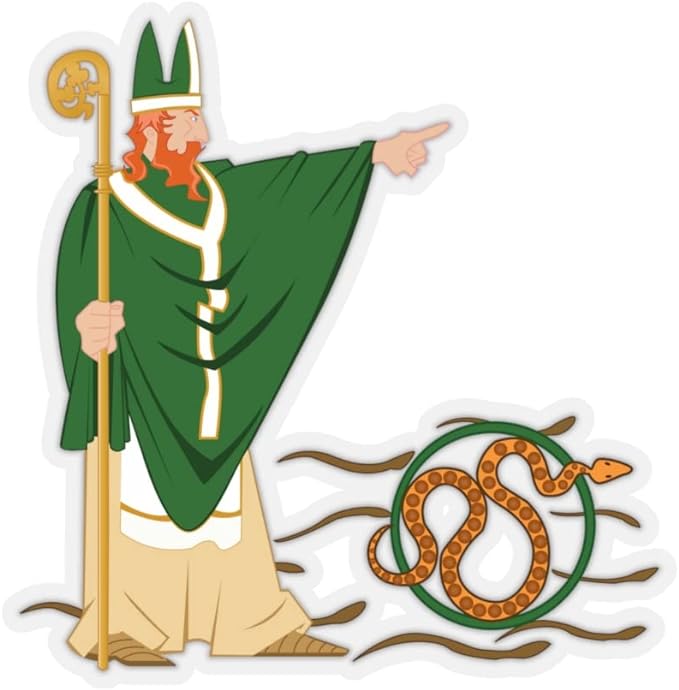
To unravel the symbolism behind St. Patrick driving the snakes out of Ireland, it is essential to delve into the ancient tradition that laid the groundwork for what we now know as Groundhog Day. In ancient Ireland, it was a customary practice for a knowledgeable woman in the community to venture out and observe the activity of Adder snakes in their hibernation holes. The presence of active snakes indicated that the Earth, the soil, was warming up, signifying the gradual retreat of winter weather. In such instances, these women would convey that the seeds for the upcoming harvest could be duly blessed, marking the official commencement of the planting season. Hence, the serpent symbol has evolved into an emblem of Paganism. https://amzn.to/3wK4vrB

The shift from the snake heralding the arrival of Spring to the revered Groundhog in America is, in essence, a perpetuation of a disguised pagan tradition. Therefore, the serpent symbol has transformed into an icon of Paganism. The change from the snake heralding the onset of Spring to the celebrated Groundhog in America is, at its core, a continuation of a concealed pagan tradition. https://amzn.to/436gcVF

There may be a continuance of using snakes symbolically in Celtic art. While traditional Celtic knot designs do not explicitly incorporate representations of snakes, they often showcase zoomorphic elements. Some interpretations propose that certain Celtic knot patterns could be associated with serpentine or reptilian forms. The complexity of Celtic knotwork allows for diverse interpretations, with symbolism influenced by cultural, historical, and individual perspectives. It’s noteworthy that in Celtic culture, snakes were not universally perceived negatively, and their symbolism could vary. For those intrigued by Celtic knot designs featuring snake symbolism, exploring contemporary artists or interpretations specializing in Celtic-inspired art may prove insightful. It’s essential to recognize that the meanings assigned to Celtic knots and their designs are subjective, with variations based on different cultural contexts and artistic expressions. https://amzn.to/49GeDQF

Groundhog Day has its origins in ancient European and Celtic traditions, particularly the festival of Imbolc. This festival, which falls around the beginning of February, marked the halfway point between the winter solstice and the spring equinox. It was associated with weather predictions and the coming of spring. https://amzn.to/49C7NvB

The specific connection between Groundhog Day and the weather forecasting groundhog can be traced back to German immigrants in the United States.
The Celts thrived in the German area during the Iron Age. Recently, within the city limits of Munich, archaeologists have unearthed an extensive Celtic village, shedding light on this ancient civilization. When the Dutch settled in Pennsylvania, the tradition of Groundhog Day grew from superstition that if a groundhog emerged from its burrow on February 2nd and saw its shadow, there would be six more weeks of winter. If it didn’t see its shadow, an early spring was predicted. The first official Groundhog Day celebration took place in Punxsutawney, Pennsylvania, in 1887. The event gained popularity over the years, and Punxsutawney Phil, the groundhog, became the most famous weather-predicting groundhog in the United States. Today, the annual tradition continues with large celebrations and Phil’s weather prediction drawing considerable attention. The activity of the Groundhog replaced the awakening snakes as a sign of the warming of planting grounds ready for a new season. https://amzn.to/3wI70e0

Many ancient holidays, rooted in pagan traditions long predating the advent of Christianity, underwent a process of appropriation and rebranding to align with Christian themes. This transformation can be likened to a subtle coup, where the Christian Church strategically incorporated existing cultural rituals and celebrations into its own framework, gradually supplanting pre-existing cultural practices. The Mother Church achieved considerable success in assimilating beloved traditions, thereby eclipsing the earlier cultural observances. https://amzn.to/3T3rjds

The timing of St. Patrick’s Day around March 17th coincides with the arrival of spring, representing renewal and rebirth. In pagan traditions, the spring equinox held significance as a time of fertility and the awakening of the earth. The legend of St. Patrick driving snakes out of Ireland is likely symbolic rather than literal. Snakes, in various cultures, often symbolize evil or the driving out of darkness. This aspect might be a Christian adaptation of older pagan symbolism. Christianity literally drove out the cultural practices that existed before the arrival of the church, literally driving those practices out, like St. Patrick driving out the snakes. https://amzn.to/3v0ahou

In addition to the aforementioned pagan practices, the revered shamrock holds significance in a longstanding Druidic tradition. Long before Ireland embraced Christianity, the island was steeped in the mystical practices of the Druids. Several symbols linked to St. Patrick’s Day, including the iconic shamrock, have deep connections to Druidic beliefs. The shamrock, characterized by its three leaves, may have held sacred meaning for the Druids, symbolizing the inherent triad found in nature. This Druidic association adds an extra layer of historical depth to the symbolism surrounding St. Patrick’s Day and its traditional emblems. Objects or concepts arranged in sets of three were readily assimilated into the framework of the Christian Trinity. The Druidic symbolism embedded in the shamrock, with its three leaves, seamlessly transitioned to represent the Father, the Son, and the Holy Spirit in Christian theology. This adaptability of pagan symbols to Christian narratives is a testament to the intentional blending of cultural practices during the conversion period, where familiar motifs found new meaning within the emerging Christian framework. https://amzn.to/3v5uR6L

Embracing festivity long into the night has its roots in the ancient tradition of lighting bonfires. This practice, inherited from pagan celebrations, predates St. Patrick’s Day. Lighting fires was once a way to ward off darkness and evil spirits, and in some areas, this tradition persists, with bonfires serving as a homage to ancient rituals. In contemporary celebrations, the focus has shifted to gathering at public houses or pubs, where the priority becomes a joyous expression accompanied by libations, now aimed at warding off gloom rather than supernatural entities. https://amzn.to/49Gqr5o

This shift in celebration sheds light on another Celtic tradition seamlessly integrated into modern St. Patrick’s Day festivities—their unique talent for infusing joy and finding laughter in every circumstance. The Celtic people’s innate ability to embrace laughter and elevate their vibrational frequency served as a crucial coping mechanism during times of persecution and conflict with the broader British Empire until eventual assimilation. This tradition endures in the heart of contemporary celebrations, where laughter remains a cherished element, bringing vibrancy and merriment to the festivities. https://amzn.to/48G27zl

It’s noteworthy that this tradition of merrymaking and humor might have played a role in the emergence of the modern phenomenon known as the “Dad Joke.” This characteristic trait appears to be ingrained in Celtic relatives, and my experiences in Great Britain revealed that those with Celtic heritage often excelled in injecting humor into situations, whether for better or for worse. It’s simply an inherent aspect of their culture. While I cannot assert these observations as historical certainties, they are speculative insights on my part. If we tune into the light-hearted melodies of much Celtic music, we can sense the pervasive joy within the culture. However, it’s essential to acknowledge that there are also tunes capable of evoking a sense of melancholy. https://amzn.to/3V6TB9A

For the most part, when passing by an Irish pub, the music emanating from within offers a glimpse into the celebratory spirit of the culture. This auditory experience has the magical ability to draw individuals in, providing a respite from the day’s drudgery. https://amzn.to/4c6t6qT

The infectious joy infused in the music fosters a sense of merriment and facilitates social bonding, creating a lively atmosphere that transcends the challenges of everyday life. https://amzn.to/49UXYIO
So, let’s not overlook what may be lost when a religious practice seeks to dominate a culture. Let’s reconnect with that ancient tradition of wise women and the profound wisdom found in nature. As we raise a glass to the past this St. Patrick’s Day, let’s acknowledge that it extends beyond the river of green and beer. https://amzn.to/3uP6OJr

Instead, let’s open our hearts to a more vibrational upliftment of joy and happiness, the kind that can endure even when adversity looms. In instances where an invading culture seamlessly replaces cherished traditions to the point where their conquest is forgotten, it becomes crucial to remember to laugh. Laugh early, laugh often, and may the road rise to meet you on a fine and blessed day.

Discover a collection of amusing products suitable for everyone to celebrate St. Patrick’s Day by visiting bartelvision | Printify Pop-Up
Explore a range of entertaining products for a delightful St. Patrick’s Day celebration. May the blessings of safety and joy uplift your spirits and elevate your frequency on this special occasion.


 Universal Vibrations Corner
Leave a comment